“AI automation consultant” gets stretched to cover almost anything at the moment: someone who sells you a chatbot widget, someone who writes a strategy document and leaves, someone who rebuilds how your enquiries get handled end to end. All three call themselves the same thing, and most of the pages selling the service describe the outcome, more time back, fewer manual tasks, and skip the part that tells you which of those three you are actually buying. Here is the plain version: what the job covers, what it does not, and what should actually land in your inbox by the end of it.
The job in one sentence
An AI automation consultant maps what your business already does by hand, works out which of those tasks are repeatable enough to hand to software, and builds the thing that does it, rather than a report telling someone else to. That last part is the part worth checking before you hire one, because it is also the part a lot of “AI consultants” quietly do not do.
What actually happens, in order
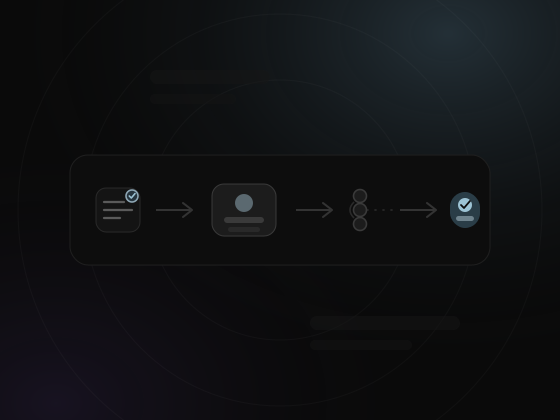
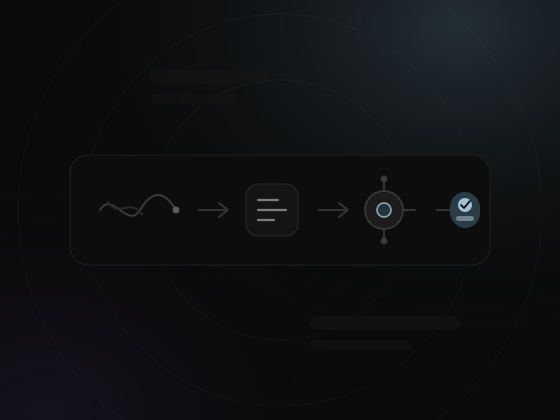
Strip away the pitch and the work breaks into the same stages whoever is doing it:
- Audit. Sitting with your actual workflow, not a template, and finding out where time genuinely goes: which enquiries get answered by hand, which reports get built from scratch every month, which admin tasks exist because nobody has had time to fix them properly.
- Prioritisation. Not everything found in an audit is worth automating first. A five-minute daily task that is mildly annoying is a lower priority than a two-hour task that happens fifty times a week, whatever the pitch deck says about “quick wins.”
- Build. The actual construction: an AI agent, a workflow, an integration between two systems that currently do not talk to each other. This is the stage a lot of “consulting” engagements stop short of, handing you a roadmap instead and leaving the build to someone else.
- Testing against real inputs. Not a demo run on a clean example, testing against the messy version: the enquiry with half the fields missing, the report with a gap in the data. Automation that only works on tidy inputs is not finished.
- Handover. Documentation and training so the system belongs to your business once the engagement ends, not just to the person who built it.
Miss the audit and you automate the wrong thing well. Miss the handover and you own a system nobody but the consultant can maintain. Both are common enough shortcuts that they are worth asking about directly before signing anything.
Consultant, developer or agency: why the label keeps blurring
Part of the confusion is that three genuinely different jobs get marketed under overlapping language. A pure AI consultant, in the traditional sense of the word, advises: audits, strategy documents, recommendations that someone else then has to implement. A developer executes a defined technical brief once someone else has already decided what to build. An agency wraps both in a team, with a salesperson, an account manager and a delivery function, so no single person you speak to necessarily builds the thing.
Where an AI automation consultant sits is deliberately in between: the audit and strategy work of a consultant, combined with actually building the output rather than handing it to someone else. That is the model I work to, and it is worth checking for directly, because “consultant” alone does not guarantee it. If the answer to “who builds this” is a different person or team to the one running the audit, you are hiring an agency wearing a consultant’s job title, which is not a problem as long as you know that going in. I have written more on when that structure suits a job better than a single-person build in AI automation agency vs freelance consultant.
What actually gets built
In practice, the work an AI automation consultant hands over tends to be some mix of the following, depending on what the audit turns up:
- Enquiry handling, so a website enquiry or a call gets qualified and routed the moment it arrives, rather than sitting in a shared inbox until someone has time.
- Content and reporting agents, handling the research, drafting or data-pulling work that currently happens by hand on a schedule.
- CRM and funnel automation, connecting the tools a business already runs so a lead does not depend on someone remembering to follow up.
- Admin and back-office tasks, the recurring, rules-based work that eats time without needing judgement each time it runs.
None of that requires replacing the team doing the work today. The point is removing the repetitive part of the job so the people doing it are left with the part that actually needs a person.
Why this has stopped being a niche hire
AI adoption among UK small businesses has moved fast enough that hiring help with it is no longer an early-adopter decision. The British Chambers of Commerce’s survey with Atos put SME AI adoption at 54% in 2026, up from 35% the year before and 23% in 2023, with the same research finding no meaningful drop in headcount at firms using it. Separately, the Federation of Small Businesses’ Confidence Code report found 59% of small firms already using AI reported productivity gains, against an estimated £42bn a year left on the table across the wider small business economy from adoption that has not happened yet.
What is not accelerating at the same rate is the success rate once a business actually starts building. McKinsey’s research on agentic AI found only around 1% of leaders describe their organisation as mature in how AI is deployed, with the gap consistently traced back to workflows that were never actually redesigned around the tool rather than to the tool itself. That is the audit-first stage above, not a footnote: skipping it is the single most common reason an automation project produces a demo instead of a working system.
Questions worth asking before you hire one
- Who actually builds it, and is that the person I am talking to now? If the answer changes between the sales call and the build, ask why.
- Is this priced before or after an audit of what I actually need? A quote handed over before anyone has looked at your process is a guess wearing a number.
- What happens to the system once the engagement ends? Documentation and training, or does it only make sense to the person who built it?
- Can I see a working example, not a demo built to look good on a call?
- What is the first thing this automates, and how will I know it worked? Anyone who cannot name a first deliverable and a way to measure it is selling a concept.
How I approach it
I work as a single-person AI automation consultant, which means the audit call, the build and the handover all sit with the same person, and every engagement inside the AI Makeover starts with that audit rather than a quote off a price list. Ten years in digital marketing underneath the AI work means what gets built plugs into a funnel and a CRM that were already designed to convert, rather than getting bolted onto whatever existed before.
For proof rather than a pitch: an automated AI receptionist I built for an events hire company now qualifies every website enquiry itself, cutting response time by 99.9% and recovering 25 hours a week that used to go on answering the same questions by hand. Elsewhere, pairing an AI content researcher with an AI copywriter lifted a client’s organic traffic 370% and conversions 60%, by publishing consistently against an opportunity that was previously too large to research by hand.
If you are trying to work out whether what you need is a single workflow built properly or a wider rebuild, that is exactly what a consultation call is for: free, thirty minutes, and a plain answer before anything gets built.