“Marketing automation consultant” is a wide enough title to cover someone who sets up a single welcome email and someone who rebuilds a company’s entire CRM. Most pages selling the service describe the benefit, more leads, less admin, a pipeline that runs itself, and skip the part that actually costs money: what gets looked at, what gets built, and in what order. Here is the version with that part left in.
What the audit covers before anything gets built
A marketing automation consultant’s first job is not automation. It is finding out what is already true about your CRM, your funnel and your data, because building on top of a mess just automates the mess faster.
That audit tends to cover the same ground whoever runs it:
- CRM health. Duplicate contacts, dead fields nobody fills in, stages that do not match how a deal actually moves. Automation built on top of bad data produces bad automation.
- Existing workflows. What is already firing, whether anyone still owns it, and whether it does what whoever built it originally intended.
- Lead flow. Where an enquiry lands the moment it arrives, and how long it sits there before a human or a sequence does anything with it.
- The email and CRM platforms themselves. Whether the tools in place can do what you are asking, or whether the plan needs a migration before it needs a workflow.
- A prioritised roadmap. Not a list of everything that is wrong, an order to fix it in, because fixing the wrong thing first is how automation projects stall halfway through.
None of that is exotic and none of it should take long. For a business running one CRM and one email platform, a proper audit is closer to a week of focused work than a month of workshops. It is also the part most likely to get skipped by anyone pricing the job before they have looked at it, which is worth noticing before you sign anything.
What actually gets built after that
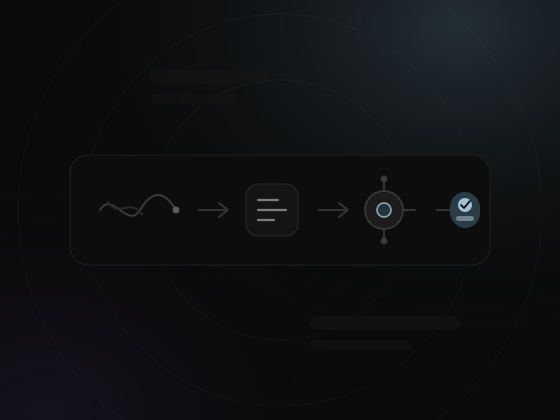
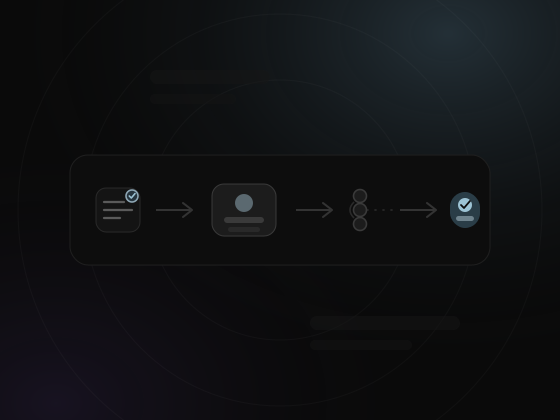
The audit produces a list. What comes off that list and into production is usually some mix of the same handful of things:
- Capture and routing, so an enquiry from any channel lands in one place, tagged with where it came from, rather than sitting in a shared inbox until someone notices it.
- Nurture sequences that respond to what a lead actually did, not a fixed schedule fired at everyone regardless of behaviour.
- Lead scoring and handoff, the rule that decides when a lead is warm enough to go to a person and who that person is.
- CRM integration, so the automation platform and the CRM agree on the same record instead of keeping two versions of the truth.
- Reporting tied to pipeline movement, not just email opens, because open rates tell you almost nothing about whether the pipeline is actually moving.
Miss any one of those and the system leaks somewhere. A nurture sequence without routing sends warm leads into a folder nobody checks. Scoring without a defined handoff person just moves the bottleneck one step further down the pipeline instead of removing it.
Why response time decides whether any of it works
The reason routing gets built before anything clever is not preference, it is how people actually respond to being followed up. HubSpot’s research on lead response and nurturing puts nurtured leads at around 20% more sales opportunities than leads left to follow up manually, and the gap widens the longer a first response takes. A beautifully written nurture sequence sitting behind a slow handoff is solving the wrong problem first.
That part is not really a software question. A platform can send a message instantly. Whether the right person acts on the reply inside the window that matters is a process question, and it is the one a consultant is actually being paid to get right.
It also is not a niche investment anymore. ONS data on AI use in UK businesses found that while a growing share of UK businesses now use some form of AI, only a small minority use it “to a great extent” to automate or streamline operations day to day. Most of the gap between those two numbers is exactly this: the difference between owning a tool and having someone build the workflow that actually uses it.
Consultant, agency or in-house: how the decision differs here
Whether you hire a consultant, an agency or build the skill in-house is a related but separate question, and I have written about that trade-off in more detail here. The short version for marketing automation specifically: a single CRM and funnel rebuild is a contained, one-person-sized job more often than it is a team-sized one, because the value is in understanding your process end to end rather than in parallel delivery across multiple systems. That changes once you are running several connected platforms that all need to keep working at once.
Questions worth asking before you sign anything
A short list tends to separate a system that runs itself from one that quietly needs someone to keep babysitting it.
- Is this priced before or after an audit? A quote handed over without anyone looking at your CRM is a guess wearing a number.
- What does the roadmap actually prioritise, and why that order? If the answer is “everything at once,” nothing is actually prioritised.
- Who reviews a nurture sequence before it goes live? Automated should not mean unread by a human.
- Does this plug into the CRM you already use, or does the plan quietly involve migrating everything? Migration can be the right call. It should be a decision, not a surprise line in the invoice.
- What does the handoff look like once the build is live? Documentation and training, or does the whole thing only make sense to the person who built it?
None of those questions assume a particular answer. They exist because the risk is the same whoever builds it: paying for automation that nobody actually owns once it is live.
How I approach it
CRM, funnel and marketing automation setup is one part of the AI Makeover, and every engagement starts with the audit above rather than a quote off a price list, because pricing before anyone has looked at your process is a guess whoever is giving it.
For proof rather than a pitch: a local marketing agency I rebuilt a CRM-driven funnel for went from stalled new business to 10 clients within 2 months, with the follow-up now running whether or not anyone is watching it. Elsewhere, blending paid advertising data with a client’s Salesforce CRM inside a paid search rebuild is what took an insurance broker’s return on ad spend from just under 100% to 300% in three months, because the automation was reading real sales data rather than guessing from clicks.
If your pipeline currently depends on someone remembering to follow up, that is worth fixing before anything more ambitious gets built on top of it. A consultation call is free, thirty minutes, and tells you plainly whether that is a single sequence or a fuller rebuild before anything gets touched.